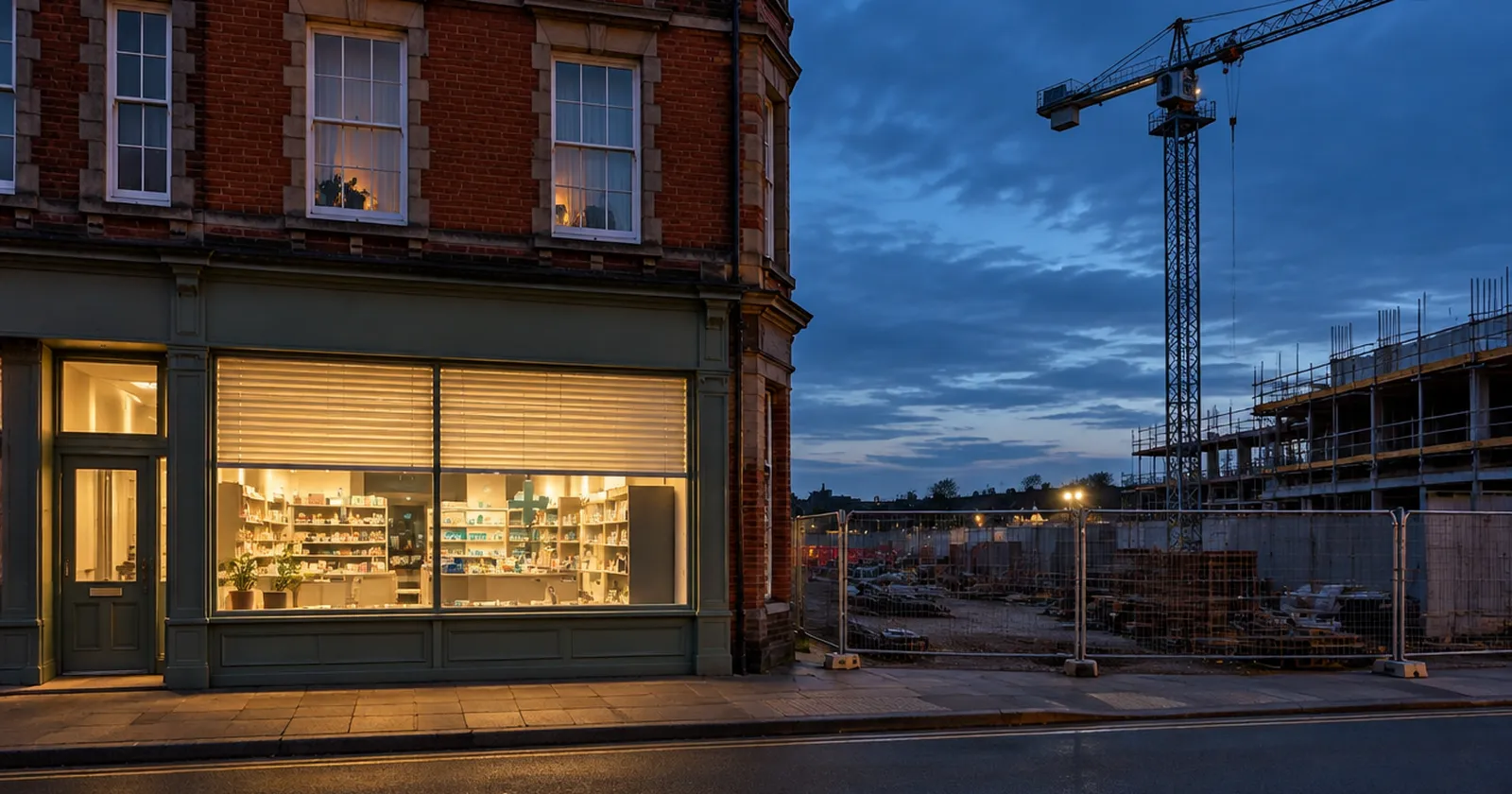
A demolition clause lets the landlord end your lease early, usually to redevelop or sell the building. A relocation clause lets the landlord move you to other premises in the building or complex. Either one can turn a ten-year lease into a much shorter one. The lease still says ten years on the front page, but the landlord holds a right to cut it off or move it, and a buyer’s bank reads the earliest date that right can be used as the real end of the lease. In our experience a pharmacy in a building with a strict demolition clause often cannot be financed at all, so the clause is a financing problem before it is a legal one.
At PharmacyBroker.ca the demolition and relocation sections are among the first things we read in any lease that comes with a pharmacy for sale, and this is the seventh article in our Lease is Everything series. It covers what the clauses are, what a forced move does to a pharmacy licence in each province, what the clause should say at minimum, and what buyers and sellers should do about one.
Why the front page of the lease can lie
The summary of a lease gives a term: ten years from a start date, with two five-year options. That is the number sellers quote and buyers model. It is also the number most likely to be wrong, because five things further back in the lease can shorten it.
Demolition rights. The landlord can end the lease on notice to demolish, redevelop or substantially renovate the building.
Relocation rights. The landlord can move the tenant to other premises. The lease survives but the location does not.
Termination rights. Some leases let the landlord, or both sides, end the lease on notice for no stated reason.
Personal options. A renewal option written for the original tenant, or one that falls away on assignment, gives the buyer nothing. The ten years is really the firm term.
Missed notices. An option that had to be exercised between 12 and 6 months before expiry, and was not, is gone. Check the dates before you count it.
All five mean the term on page one is a maximum, not a promise. Article 1 covers how the bank reads the lease term. This article covers the two clauses that most often cut it short.
What a demolition clause is and why landlords want one
A demolition clause (sometimes called a redevelopment clause or a landlord’s termination right) lets the landlord end the lease before expiry, on a set notice period, if it decides to demolish or redevelop the building. Some versions require a real project with permits and pay the tenant for the unamortized cost of its improvements. Many require neither.
Landlords of older buildings want the clause because the building may be worth more as land than as a plaza of small tenants. In our experience it is common in older strip plazas and medical buildings where the landlord wants an exit if it cannot sell the building as it stands, or if a development comes along. Sensible for the landlord. For the pharmacy it means the lease can end at the landlord’s choice, with the notice period often the only protection.
In recent pharmacy sale files, the demolition clauses looked like this (no building or store named):
- One medical building lease allowed the landlord to terminate on 6 months’ notice with no compensation. The same lease had no renewal option and an uncapped personal indemnity.
- One street retail lease allowed termination on 12 months’ notice, but not before a stated year about a decade out. That is close to what a clause should look like.
- One downtown lease gave either side a 120-day termination right, written so the landlord could redevelop.
A financing problem before it is a legal problem
Lawyers read a demolition clause as a legal risk: what triggers it, how much notice, what compensation. Buyers should read it first as a financing question, because the bank decides before the lawyer does. Every lender we have worked with sets a pharmacy loan’s amortization from the remaining lease term, including solid options. A demolition clause that can be exercised in year three makes the secure term three years. In our experience, buildings with a strict demolition clause often cannot be financed at all. No lender wants to lend ten years of money against a location that can disappear on six months’ notice. The best case is a shorter amortization and a much larger down payment, which shrinks the pool of buyers who can close. The worst case is no lender, and a pharmacy for sale that can only be bought for cash. Before anyone argues about whether the clause is fair, find out whether a bank will lend against it.
What the clause should say at minimum
The best demolition clause is no demolition clause. Where the landlord insists, this is what we look for, in order of preference. Have your lawyer draft the words; these are the concepts.
Not exercisable before the end of the lease including options. This is Arash’s own rule for the leases he signs and the minimum we recommend. If the landlord can only use the clause after the last option expires, the buyer and the bank get the full term, and the landlord still has its exit once the lease would have ended anyway.
Failing that, each of the following makes the clause less damaging:
- A long notice period. Twelve months is far better than six, and twenty-four better again. A pharmacy needs time to find premises, build, get licensed and move patients.
- Proof of a real project. Exercisable only when the landlord holds a development permit or a signed construction contract, not a plan to have a plan. Without this, the clause is a general termination right in disguise.
- Compensation. At minimum the unamortized cost of leasehold improvements, and ideally moving costs and a contribution to lost earnings.
- An alternative premises right. A right of first refusal on space in the redeveloped building, or in other space the landlord owns nearby, on the same terms for the balance of the term.
- The latest possible earliest date. If the landlord will not push the date past the options, push it as far as it will go. A clause that cannot be used for the first eight years of a ten-year term is a very different clause from one that works from day one.
The tenant who does not raise any of this gets the landlord’s standard form.
Relocation clauses in malls and medical buildings
A relocation clause is the mall and medical building version of the same problem. The landlord does not end the lease; it moves you, on notice, to other premises of comparable size in the building or complex, with the lease continuing on the same terms.
One plaza lease in our files let the landlord relocate the tenant at any time, paying moving costs, with no other recourse for the tenant. That is the weak end. A relocation clause should answer five questions.
- Equivalent premises. Comparable size, frontage, visibility, ground floor access and parking. “Comparable” should be defined, not left to the landlord.
- Who pays. All moving costs, fit-out of the new space to the same standard, new signage, and the cost of relicensing. A dispensary is not a clothing rack.
- Downtime. Rent abatement while the pharmacy cannot trade, and ideally a contribution to lost earnings. A clause that moves you over a weekend works for a kiosk, not for a dispensary that has to pass an assessment before it opens.
- Notice. Long enough to apply to the College and the payers, which in most provinces means 30 to 90 days before the move, plus the build.
- A right to terminate instead. If the only space offered is worse, the tenant should be able to walk away without penalty.
What a forced move does to a pharmacy
For most retailers a relocation is a bad month. For a pharmacy, in most provinces, the regulator treats it as a new opening.
The licence attaches to the premises. Move them and in most provinces the old licence is cancelled and a new one issued, with a new application, a floor plan, a self-assessment or inspection, and in several provinces a new provider or accreditation number, which means new accounts with the provincial drug plan, private payers and the wholesaler. The compact version by province, summarised from each regulator’s published route:
| Province | What a move to a new address does to the licence |
|---|---|
| BC | Licence cancelled; the new location cannot open until a new licence issues. Apply at least 30 days ahead with a scaled diagram. On-site inspection generally not required if digital evidence shows compliance. |
| Alberta | A nearby move serving the same patients is a relocation; anything more is a new pharmacy application. Old licence terminates, new licence number, new Alberta Blue Cross and wholesaler accounts. Apply at least 45 days ahead; inspection after the move. |
| Saskatchewan | The permit names the address. A change can mean an amendment or a new application at the College’s discretion, with a pre-opening inspection at the Registrar’s discretion. |
| Manitoba | Relocations require an inspection arranged in advance with the College. |
| Ontario | A move to a new address is equivalent to opening a new pharmacy: new Certificate of Accreditation and an assessment, application at least 45 days before opening. A move between units at the same address follows the renovation route. |
| Quebec | The move must be declared to the OPQ 30 to 90 days beforehand, with the lease. No automatic inspection is set out on the page we reviewed. |
| New Brunswick | Relocation submitted at least 30 days before opening; the new premises must meet the College’s requirements. |
| Nova Scotia | A new pharmacy licence is required for a change of location, with at least 30 days’ notice, a diagram and an inspection of the new premises. |
| PEI | Application at least 15 days ahead, public notice, a self-assessment, and a site assessment within 30 days after the move. |
| Newfoundland and Labrador | Application at least 90 days ahead with a floor plan, inspection before reopening, self-assessment, public notice and Pharmacy Network connection. |
Not every province inspects before reopening; Alberta and PEI assess after the move. But in every province the licence is tied to the address, and the paperwork, payer setup and timing have to line up with the day you hand back the keys. The Ontario, Alberta, BC and Newfoundland and Labrador pages are a good start; rules change, so confirm with your College.
Then there are the patients. A pharmacy’s goodwill is the habit of a few thousand people filling prescriptions at one address. Records move with you; patients do not have to. Those who live nearby or use the clinic upstairs may simply go to the pharmacy that is now closer. Nobody can tell you in advance what share will follow, and the buyer’s bank will not assume it is all of them.
The worst case is a gap. If the new premises are not ready, or the licence has not issued, when the old premises must be vacated, the pharmacy closes. A closure of a few months between locations is a huge problem: no revenue, staff drifting away, patients re-routed by their clinics, and a brand new opening at the end of it. In our experience that risk alone can stop a sale.
Two stories and a number
The relocation that stopped a deal. In a sale we were working on recently, a relocation surfaced during the process, nobody could say with confidence what the new space would cost to build or how many patients would move with it, and the deal did not survive the uncertainty.
The announced redevelopment. In another deal, a pharmacy we valued was asked to move to another level of its complex under a redevelopment plan the landlord announced while we were working on it.
The number. The research behind this series illustrates the cost side. Suppose a forced move costs $250,000 in year three (fit-out, moving, relicensing, signage) and nothing is recovered from the landlord. At an illustrative 20 percent discount rate, the present value of that cost today is about $145,000. That is a straight deduction from what a buyer should pay, before any allowance for lost earnings and patients who do not follow, which have to be modelled separately. On our standard $1.5 million pharmacy, the move cost alone is close to a tenth of the price. An illustration, not market data.
The Quebec super-clinic: a long lease is not a shield either
The opposite warning comes from Quebec. In 9745866 Canada inc. c. 9518002 Canada inc. (2021 QCCA 1530), a pharmacy tenant in a medical super-clinic held a 15-year lease plus renewal options. It took possession in 2017 and had not opened more than a year later. The landlord terminated, and in October 2021 the Quebec Court of Appeal upheld the termination, treating the failure to operate as a serious default equivalent to a change of use under the lease. Fifteen years on paper did not protect a tenant that was not operating. Quebec’s real estate regulator has a plain-language summary of the case.
The lesson is that a long lease carries duties as well as rights. Continuous operation clauses, opening deadlines and minimum hours are common in medical buildings and malls, where the landlord needs the pharmacy open to serve the clinic or anchor the plaza. A pharmacy that goes dark for a renovation, loses its manager, or sits closed between a sale and a licence transfer can be in default. The case turned on its own facts and Quebec civil law, not a general Canadian rule. But read your operating covenants as carefully as the landlord’s termination rights.
This is general information, not legal advice. Have your lawyer read your lease.
What a buyer should do when the clause is there
You find a pharmacy for sale you like, and the lease has a demolition clause exercisable from year four on six months’ notice. In order.
- Get the lender’s answer first. Send the lease to your bank before you negotiate price. Ask how it treats the clause, what amortization it will offer, and whether it will lend at all.
- Price it. If a lender will proceed, model the clause: the present value of the move cost, a probability-weighted hit to earnings, and the shorter amortization. Then decide what the pharmacy is worth to you with the clause in it.
- Make removal a condition. Your letter of intent and purchase agreement can be conditional on the landlord amending the lease: delete the clause, push its earliest date past the options, add compensation. Sellers often have more pull with a landlord than they think.
- Walk if you must. A pharmacy in a building that may come down is a short-term business priced like a long-term one. If the landlord will not move and the lender will not lend, you have your answer.
In Rabin v. 2490918 Ontario Inc. (2023 ONCA 49), a landlord answered a dentist’s assignment request by asking for a new demolition clause on 24 months’ notice as the price of consent, after missing the lease’s response deadline; the Court of Appeal ordered relief equivalent to consent. A demolition clause can appear during a sale, not only at signing. Do not accept one at assignment without your lender’s view and your lawyer’s.
What a seller should do before listing
If you are a year or two from selling, deal with these clauses now, while nobody is waiting on you. Article 8 covers fixing the lease before you list in full. The demolition and relocation points are these.
Find the clause. Read the whole lease, not the summary. Demolition rights hide under “landlord’s termination”, “redevelopment” or “substantial renovation”.
Negotiate it out. Ask the landlord to delete it, usually alongside an extension or new options. A landlord with no redevelopment plan often agrees, sometimes for a modest rent increase. Get the amendment signed and attached to the lease; a verbal assurance is worth nothing to a buyer’s bank.
Push the earliest date past the options. If the landlord will not delete it, move the first date it can be used to after the last option expires. The buyer gets the full term and the bank gets its amortization.
If neither works, price for it. A buyer’s lender will treat the earliest exercise date as the end of the lease. Price the pharmacy on that term, or expect the buyer to.
Lease clauses that protect a future sale covers the other clauses to negotiate at the same time. If your pharmacy sits inside a clinic or medical building, our guide to valuing a pharmacy with a medical clinic covers what that relationship is worth and what a move does to it.
Build the time in
These clauses cost time as well as money. A relocation application takes 30 to 90 days in most provinces before the move, plus the build. In our experience a lender wants the lease settled about four weeks before closing. Put all of that into the sale timeline before you set a closing date. A lease fix that starts after the LOI is one of the most common reasons we see closings move.
If your lease has a demolition or relocation clause and you are thinking about selling, request a valuation and send the lease with the financials. We will read the clause the way a buyer’s bank will, tell you what it does to the number, and what we would do about it before listing.